Daily Bible Study: Audio, Plan
- 4.6
- Rating
- 10.00M
- Installs
- Free
- Price

 Analysis by App-foxy
I found Daily Bible Study: Audio, Plan most useful when I treated it as a flexible companion for a regular Bible habit rather than as a replacement for a printed Bible or a detailed study reference. It brings reading plans, daily verses, devotional material, audio content, and podcasts into one place, which makes it easier to return to Scripture during ordinary gaps in the day. My overall view is positive: this is a welcoming, practical app for people who want structure and encouragement, although readers looking for deep scholarly tools may eventually need something more specialized.
The app is developed by Salem Media Group and sits in the Books & Reference category. It is free to download, with optional in-app purchases ranging from $0.99 to $100.00 per item. That combination matters because the basic idea is easy to try without committing money, while some extras may require a closer look before purchasing. The app is rated for Everyone, so it is designed to be approachable for a broad audience rather than only experienced Bible readers.
How Daily Bible Study fits into real life
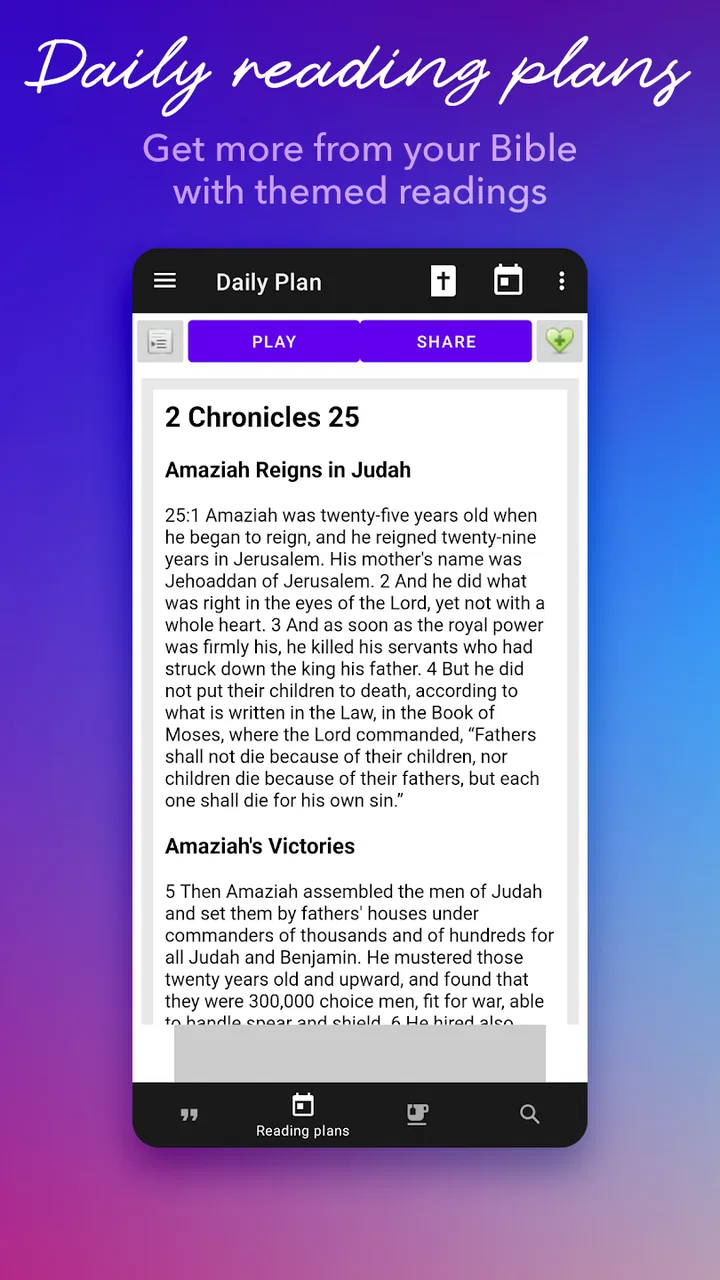
The best part of the experience is its ability to turn an intention into a routine. Many people do not struggle because they lack interest in the Bible; they struggle because they do not know where to begin, lose their place, or find it difficult to protect a quiet moment. A reading plan gives that moment a shape. Instead of opening a large collection of books and wondering what to read, I can follow a guided path and make a small amount of progress.
You May Also Like

 Blood Strike: 2.5 Anniversary
Blood Strike’s Loadouts Turn Every Drop Into a Tactical Gamble
A close look at Blood Strike’s custom loadouts: how fast access to signature weapons reshapes its battle royale rhythm, rewards preparation, and narrows the gap between fights.

 Pandora - Music & Podcasts
Pandora’s Music Is Easy to Start, but Harder to Recover
Pandora’s strength is its low-effort path from a seed to a station. Its weak spot is how much confidence it asks you to place in connection, setup, and quiet recovery.

 8 Ball Pool
 Is Built on Rivalries, Rematches, and Routine
A close look at the rivalries, rematches, shared routines, and unanswered safety questions that turn a quick pool match into a persistent mobile community.

 Samsung Music
’s Quiet Strength Is Playing What You Already Own
Its reach comes less from spectacle than from dependable access to a personal library. That simplicity is both the app’s strongest retention engine and its ceiling.

 AccuWeather: Weather Radar
AccuWeather Review: A Quick, Clear Forecast for Everyday Decisions
For everyday plans, the best forecast is the one you can understand quickly. AccuWeather makes rain timing, radar, and local conditions easy to act on, with a few trade-offs.

 Hill Climb Racing
Why Hill Climb Racing Still Turns Crashes Into One More Run
A tiny car, a bumpy hill and one more upgrade: Hill Climb Racing keeps resurfacing because its simple chaos makes every near-miss feel personal.
More From Our News Desk
View All News


I also like the mix of formats. Reading suits a quiet morning, while audio is more practical during a commute, a walk, household chores, or a short break away from a desk. Devotional material adds a reflective layer, and podcasts can make the app feel less like a static reference shelf. These formats serve different moods, so the app is more adaptable than a single-purpose Bible reader.
A realistic everyday routine would be to read the day’s passage with breakfast, listen to related audio while getting ready, and return to the devotional thought in the evening. That is not a demanding system, and it avoids the common mistake of making a personal study habit so ambitious that it collapses after a few days. I would recommend starting with one consistent time and one format, then adding audio or podcasts only when they genuinely help.
The store summary describes daily Bible reading plans, a verse, devotional content, and audio podcasts, and that combination accurately reflects the app’s appeal. It is not simply a digital page-turner. Its value comes from placing several ways of engaging with Christian content close together, allowing me to choose between focused reading and more passive listening without changing apps.
A gentle starting point for new readers
For someone who has never built a Bible-reading habit, the guided approach is less intimidating than choosing passages at random. The app can act as a starting point for learning how a daily rhythm feels. I would still encourage new readers to slow down and think about context rather than treating a completed daily item as the goal. A plan is useful because it provides direction, not because speed is the measure of understanding.
Experienced readers may appreciate the convenience in a different way. Instead of needing separate tools for a reading schedule, a verse of the day, spoken content, and devotional prompts, they can keep those activities together. That does not make the app a complete theological library, but it can reduce friction when the goal is consistency.
Why the audio option changes the experience
Audio is more than a decorative extra here. It changes when the app can be used. A printed Bible requires a free hand and a suitable setting, while spoken content can fit into parts of the day that would otherwise be lost. I found this especially valuable for maintaining contact with the material on busy days, although listening should not automatically replace slower reading when I want to examine wording or reflect carefully.
There is also a useful trade-off between convenience and concentration. Audio works well for exposure and continuity, but it is easier to miss a sentence while walking or doing chores. My practical tip is to use listening for a first pass, then return to the written passage when something catches my attention. That two-stage approach makes the audio feature supportive rather than a substitute for thoughtful reading.
Podcasts serve another purpose. They can provide a broader listening experience than a short daily reading, which is helpful when I have more time or want material that feels conversational. At the same time, podcasts are less predictable than a fixed plan. I would use them as an optional extension, not as the foundation of a habit that depends on a clear sequence.
Small workflows that make the app more useful
One effective workflow is to separate “minimum” and “extra” activities. The minimum might be the day’s reading or verse, while the extra is a devotional or podcast when time allows. This prevents a missed podcast from feeling like a failed study session. It also makes the app suitable for changing schedules, which is important because a plan that only works on ideal days is not much of a plan.
A second useful approach is to connect the app to a specific daily trigger rather than relying on motivation. I would open it after making coffee, before bed, or immediately after a regular walk. The content then becomes attached to something already happening. This is a simple habit-building technique, but it matters more here than collecting a large number of resources that I never actually open.
A third tip is to choose the format based on the purpose of the moment. Use written reading when you want to notice details, devotionals when you want a short reflective prompt, and audio when the day is crowded. Treating every feature as interchangeable can make the app feel unfocused; assigning each one a job makes the collection feel intentional.
Where it falls short and who should choose it
The main weakness is that convenience can sometimes make the experience feel broad rather than deep. Reading plans, verses, devotionals, audio, and podcasts cover several needs, but users seeking extensive cross-references, original-language tools, detailed commentary, or a highly configurable study workspace may find the app limited compared with dedicated Bible-study software. I would not choose it as my only tool for serious research.
There is also a possible attention problem. When several kinds of content sit beside one another, it is easy to move from a meaningful reading session into casual browsing. That is not necessarily a flaw in the app itself, but it affects how I use it. If my goal is focused study, I would open the selected plan and avoid treating every recommendation as something I need to consume.
The free entry point is helpful, but the presence of optional purchases means I would pay attention before confirming any transaction. A free app can still become expensive if a user assumes every extra is included. I would begin with the core experience, decide whether it fits my routine, and only then consider paid items that have a clear purpose.
Another limitation is personal fit. Someone who already owns a preferred Bible app, follows a church reading schedule, and listens to podcasts elsewhere may not gain much from consolidating those activities. In that case, Daily Bible Study may feel like another layer rather than a simplification. The strongest reason to use it is not that every individual feature is unique, but that the combination can make a regular habit easier to maintain.
How it compares with familiar alternatives
Compared with a paper Bible, the app offers more guidance and more ways to listen, but it also introduces screens and distractions. Paper remains better for people who want a calm, annotation-friendly reading environment. Compared with a basic Bible reader, this app places greater emphasis on plans, devotional material, and audio content. A basic reader may be preferable when I already know exactly what passage I want and do not need encouragement or structure.
Compared with a specialist study platform, this app is more approachable and less demanding. A specialist tool may win for research, comparison, and detailed interpretation, while Daily Bible Study is better suited to an everyday rhythm. I see it as a bridge between a simple verse app and a full study library: more supportive than the former, less exhaustive than the latter.
That middle position explains both its strength and its boundary. It can help a casual reader become consistent and help an experienced reader keep a portable devotional routine. It is not designed to answer every interpretive question, and I would avoid expecting it to do so.
Who will get the most from it?
I would recommend Daily Bible Study: Audio, Plan to people who want a clear starting point, enjoy switching between reading and listening, or have struggled to keep a daily practice alive. It is also a sensible choice for households where different people prefer different formats. One person can read, another can listen, and both can use the same general resource without needing an elaborate setup.
The app is especially suitable for busy adults who need flexibility. A short reading in the morning and audio later can be more realistic than reserving a long uninterrupted session. It may also suit someone returning to Bible reading after a long break, because the plan-based approach reduces the pressure of deciding what to do next.
I would suggest skipping it if your main requirement is academic depth, extensive note-taking, or a highly controlled study environment. In those situations, a dedicated reference app or physical study Bible may serve you better. I would also skip it if you dislike devotional prompts and prefer to navigate only by book, chapter, and verse. The app’s strength is guidance and variety, so users who want a bare reading tool may find that approach unnecessary.
On supported devices, the current version is 7.42.1 and requires Android 7.0 or later. That makes it relevant to many Android users, but anyone with an older phone should check compatibility before planning around it. Since it is free to install, trying the core experience is relatively straightforward, provided I keep the optional purchase model in mind.
My final recommendation
Daily Bible Study: Audio, Plan succeeds because it focuses on the practical problem of returning to Scripture regularly. Its reading plans provide direction, its devotional material adds reflection, and its audio and podcast options make the habit easier to carry into busy parts of the day. I found the app most convincing when I used it simply: one daily reading as the anchor, audio as a backup for crowded days, and longer content only when I had the attention for it.
Its popularity is substantial, with over ten million installs, around two hundred ten thousand ratings, and an average rating of 4.6. Those figures suggest that the format connects with a large audience, but they do not remove the need to judge whether its style suits you. The Everyone age rating also makes it broadly approachable, though individual preferences about devotional tone and study depth will still matter.
My verdict is that this is a strong free starting point for a consistent Christian reading and listening routine, not an all-purpose research library. I would recommend it to a friend who wants structure without a complicated setup, especially if that friend often has to fit spiritual reading around work, travel, or family responsibilities. I would pair it with another reference source for detailed study, but for everyday encouragement and a manageable plan, the app’s real strength is making the next reading session easy to begin.
FAQs for Daily Bible Study: Audio, Plan
01What is Daily Bible Study: Audio, Plan?
Daily Bible Study: Audio, Plan is a devotional and Bible-reading app designed to help users build a consistent spiritual routine. It typically combines daily Scripture passages, guided reading plans, study material, and audio playback. The format is suitable for short personal sessions, whether you prefer reading quietly, listening while commuting, or following a structured plan over several days or weeks.
02Does Daily Bible Study: Audio, Plan include audio Bible content?
Yes, audio is one of the app’s main features, allowing users to listen to Bible passages or devotional material instead of reading everything on screen. This can be useful during travel, exercise, or other hands-free situations. Before downloading, check your device’s volume settings and the app listing for information about available languages, narration, offline listening, and whether all audio content is included for free.
03Are the Bible reading plans suitable for beginners?
The app is generally suitable for both newcomers and experienced Bible readers because plans can provide a clear starting point and a manageable daily schedule. Beginners may appreciate short passages, explanations, and reminders, while regular readers can use longer or themed plans for more focused study. The best experience depends on selecting a plan that matches your preferred pace and level of familiarity.
04Does Daily Bible Study: Audio, Plan work offline?
Some features may remain available without an internet connection, but offline access can vary depending on the specific Bible version, audio files, and study plan. Text that has already loaded may be accessible offline, while streaming audio or newly opened content may require mobile data or Wi-Fi. If you plan to use the app away from home, download any available materials in advance and review its storage permissions.
05Is Daily Bible Study: Audio, Plan free to download and use?
The app may be free to install while offering a mixture of free and premium content. Basic reading plans or selected passages could be available without payment, whereas additional translations, audio resources, advanced studies, or an ad-free experience may require a subscription or one-time purchase. Check the current Google Play or App Store listing carefully, including trial terms and renewal conditions, before subscribing.
Pros
- Audio readings make it easy to study while commuting or doing chores.
- Study plans help users follow a consistent reading routine.
- Daily reminders encourage regular Bible engagement.
- Simple navigation makes chapters and plans easy to access.
- Useful for users who prefer guided
- bite-sized devotional content.
Cons
- Some study plans or features may require a premium subscription.
- Audio quality and narration style may vary between Bible versions.
- The app can feel limited for users seeking advanced scholarly tools.
- Notifications may become repetitive if many reminders are enabled.
- An internet connection may be needed for some audio or content features.

Daily Bible Study: Audio, Plan
Gallery